

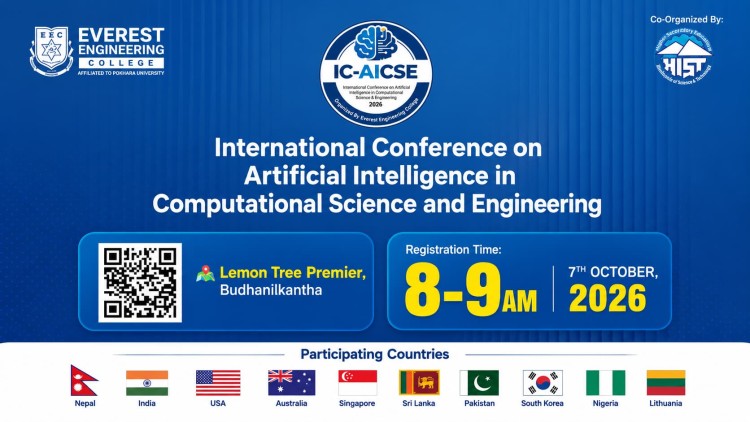
IC-AICSE 2026 is the International Conference on Artificial Intelligence in Computational Science and Engineering. Everest Engineering College, affiliated to Pokhara University, hosts it on 7 October 2026 (21 Asoj 2083) at Lemon Tree Premier, Budhanilkantha, Kathmandu. Hist Engineering College is the co-organizer. More than 200 participants and over 40 research papers are expected.
Full name: International Conference on Artificial Intelligence in Computational Science and Engineering (IC-AICSE 2026)
Date: Wednesday, 7 October 2026 (21 Asoj 2083)
Venue: Lemon Tree Premier, Budhanilkantha, Kathmandu, Nepal
Organizer: Everest Engineering College, affiliated to Pokhara University
Co-organizer: Hist Engineering College
Scale: 200+ participants, 40+ research papers, papers from 10 countries
Format: Expert reviewed papers presented in parallel technical sessions
Technical partner: IEEE Nepal Section
Knowledge partner: Nepal Engineers' Association
Recognition and support: Recognized by the Nepal Engineering Council, with support from the University Grants Commission
IC-AICSE 2026 is a one day international conference that connects artificial intelligence with research, teaching and practical problem solving. Everest Engineering College organizes it with Hist Engineering College, and the event takes place on 7 October 2026 at Lemon Tree Premier in Budhanilkantha, Kathmandu.
The conference expects more than 200 participants and presents over 40 research papers. Papers from 10 countries will be presented, which gives Nepali students and faculty a rare chance to hear international work without leaving Kathmandu. Every accepted paper is chosen through expert review and then presented in parallel technical sessions, so attendees can follow the track closest to their own field.
The central message is simple. Artificial intelligence should be tied to research, to classroom learning and to real problems. Scientists and engineers hold large amounts of data, and turning that data into meaningful knowledge, analyzing complex problems and improving decisions all need conversation between experts from different disciplines. The conference is built as a place for that conversation: presenting new ideas, receiving constructive feedback on research findings and spotting chances to collaborate.
The conference is led by senior academics from Nepal's university community. The chief guest is Prof. Dr. Chandramani Poudel, President of Bagmati University. The conference chair is Prof. Dr. Harikrishna Shrestha, and the member secretary is Associate Professor Er. Rajan Lama.
Institutional support comes from several recognized bodies. IEEE Nepal Section serves as the technical partner, and the Nepal Engineers' Association is the knowledge partner. The conference carries recognition from the Nepal Engineering Council and receives support from the University Grants Commission. The host college is affiliated to Pokhara University.
The conference covers six thematic areas. Each one links artificial intelligence to a field where Nepali researchers and students already work.
1. Computer engineering and information technology. Core computing research and the software systems built on it.
2. Computational science. Modeling, simulation, and data-driven methods applied to scientific questions.
3. Cybersecurity and digital forensics. Protecting systems and investigating digital evidence.
4. Financial technology. Digital tools and analytics for finance and payments.
5. Civil engineering. Infrastructure, construction and the built environment.
6. Environmental science and engineering. Environmental monitoring, risk and sustainability.
This spread matters because the conference does not treat artificial intelligence as a topic for computer scientists alone. A civil engineer studying infrastructure and a cybersecurity researcher studying digital evidence can sit in the same event and compare methods.
Artificial intelligence discussions become most useful when they connect to local needs and local problems. For Nepal, the conference organizers point to several areas where research can begin:
Assessing the condition of infrastructure
Managing transport and traffic
Analyzing data about water resources
Identifying environmental risks
Improving public services
Turning these possibilities into practice takes more than a good algorithm. It needs suitable data, subject knowledge, reliable technology, and a clear understanding of local conditions, all moving forward together. A model trained without local context may produce results that look precise but fail on Nepali roads, rivers or public offices. That is why the conference places subject experts and AI researchers in the same rooms.
Presenting a paper at IC-AICSE 2026 is more than sharing a study. It is practice in refining research methods, using evidence well, and interpreting conclusions with care. Students and young researchers also gain from direct contact with experts and from hearing how other researchers approached their problems.
That exchange can help a young researcher find new research questions and set the direction of future studies. It also links classroom learning to research and professional practice, which is a gap many engineering students feel in their final years. For students of computer, IT, software and civil engineering, the conference offers an early look at how academic work is reviewed, questioned and improved.
The conference gives priority to responsible use alongside usefulness. When an AI-based solution is evaluated, five things need attention:
Data quality: weak data produces weak conclusions.
Privacy: personal and sensitive data must be protected.
Fairness: results should not disadvantage particular groups.
Transparency: people should be able to understand how a result was reached.
Human accountability: a person remains answerable for the decision.
This is especially important for engineering decisions linked to public safety and public services. An output from a technology tool should be combined with subject level testing and the judgment of an expert before anyone acts on it.
Everest Engineering College is an engineering college in Sanepa, Lalitpur, Nepal, affiliated to Pokhara University. It offers Bachelor of Engineering programs in Civil, Computer, IT, and Software Engineering. Hosting IC-AICSE 2026 fits the college's focus on research and practical learning. To explore programs, admissions and notices, visit the Everest Engineering College website.
IC-AICSE 2026 brings researchers, educators and students together on 7 October 2026 to discuss how artificial intelligence can support science and engineering in a responsible way. With over 40 research papers, participants from several countries, and six thematic areas, it is one of the larger academic gatherings of the season in Kathmandu. Students and faculty who want to learn how AI research is shaped, reviewed and applied to local problems have good reason to attend.