

Experts are calling for a serious rethink of hydropower project design and safety standards in Nepal, along with real-time monitoring of glacial lakes, glaciers, and high mountain zones, and stronger river-basin-level risk assessment.
The recent flood in the Bhotekoshi River was not caused by a glacial lake bursting, according to stakeholders. Instead, it is believed to have originated as a large mass of snow and ice that broke off and melted in the high mountains, an event increasingly being described as a "glacial flood" rather than a classic Glacial Lake Outburst Flood (GLOF).
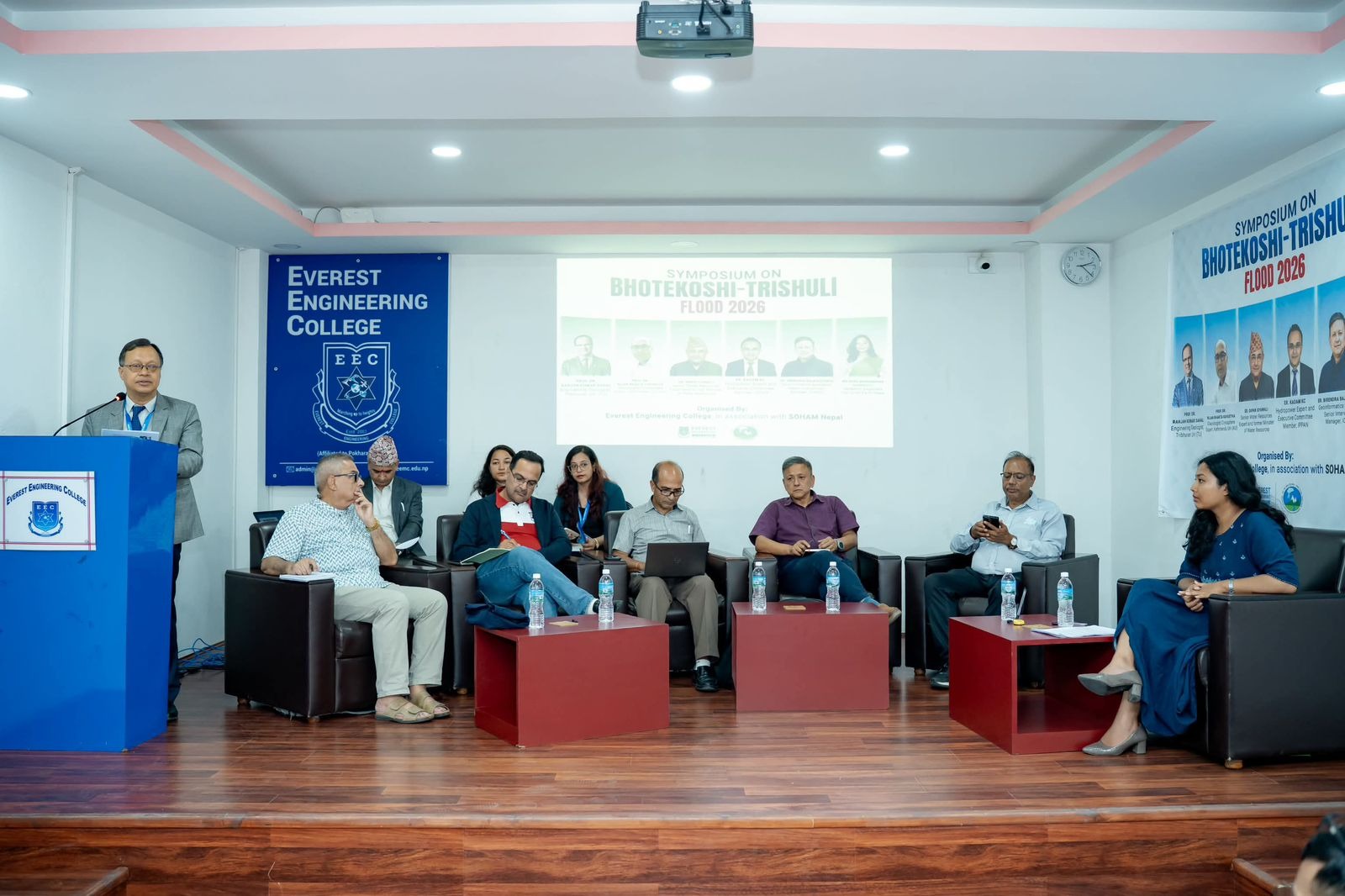
The discussion took place at a program organized by the Meteorological Society of Nepal, hosted by Everest Engineering, focused specifically on the Bhotekoshi–Trishuli flood. Participants agreed that the flood's nature, intensity, and the scale of the damage point to gaps in how Nepal currently monitors glacial hazards, issues early warnings, and designs hydropower infrastructure.
Rijan Bhakta Kayastha, a glaciologist at Kathmandu University, explained the sequence behind the disaster. A large chunk of ice broke away at an elevation of roughly 5,200 meters. By the time it descended to around 3,800 meters, it had melted. That meltwater then mixed into the river near 2,900 meters, forming a powerful surge. This surge reached Rasuwa, at an elevation of about 1,700 meters, as a high-velocity flood.
Kayastha noted that Nepal has close to 2,354 glacial lakes and hundreds of glaciers, making an effective early warning system along rivers essential. He stressed that monitoring cannot be limited to glacial lakes alone, glaciers and high-altitude zones need continuous observation too. He also pointed to a persistent problem: communities keep settling in areas that rivers have already shown they can reach. Even though it is difficult to design structures for floods of this scale, he argued that design standards must be revised with this risk in mind.
He recalled a similar high-altitude flood event in Rasuwa the previous year, which originated at around 2,900 meters. Because glacier- and glacial-lake-related disasters tend to occur during the monsoon, he recommended that monitoring and preparedness in risk-prone areas begin before the monsoon season starts, not after.
Geologist Ranjan Kumar Dahal described the event as an environmental "catastrophe" that shouldn't be viewed through the lens of climate change alone, even though climate change is clearly a contributing factor. He noted that discussions about transboundary risk and information-sharing with China had already begun after last year's flood event. While a basis for cooperation between Nepal and China exists, he said it hasn't yet been translated into effective diplomatic action.
Dahal called for a shift toward real-time observation systems, backed by a dedicated mechanism or committee to drive this work forward. He also urged Nepal to present its climate risk case internationally backed by hard data, rather than relying on conventional arguments, preparing scientific evidence and documentation to engage the international community more effectively.
He acknowledged that while a database of high-risk glaciers and glacial zones already exists, the state's limited resources make it impossible to monitor every area equally. That makes prioritizing the highest-risk zones a necessity, not an option.
On hydropower specifically, Dahal said design standards need to catch up with the new risk landscape. Project design has traditionally leaned toward conservative assumptions while keeping cost in mind, but he argued that risk needs to be given far greater weight in design decisions, since doing so could meaningfully reduce future damage.
Birendra Bajracharya of the International Centre for Integrated Mountain Development (ICIMOD) said satellite technology is useful for disaster monitoring in high mountain areas, but investment in technology alone won't solve the underlying problem. Cloud cover during the monsoon makes direct satellite monitoring difficult, and reaching high-altitude zones for on-the-ground study presents major logistical challenges.
Rather than pouring new investment into additional satellites to monitor Nepal's thousands of glaciers, Bajracharya suggested focusing on making better use of data already available from existing international satellite systems.
Former Water Resources Minister Deepak Gyawali said that while rising global carbon emissions are a global problem Nepal cannot solve alone, the country still bears the consequences and must adapt its infrastructure accordingly. He called for a rethink of the practice of building settlements and roads close to riverbanks, arguing that roads should be built in comparatively safer locations, even if that adds cost. "These kinds of disasters are, to a large extent, tied to natural processes," he said. "So instead of focusing only on relief and rescue after the fact, we need long-term planning and preparedness."
Gyawali also raised concerns about hydropower investment and risk management more broadly. With more than 40 percent of Nepali insurance companies' investment concentrated in the hydropower sector, he warned that a major natural disaster could significantly increase risk exposure across the insurance industry as a whole.
He argued that Nepal should reduce its reliance on run-of-river hydropower and shift more investment toward reservoir-based and pumped storage projects. He also pointed out that Nepal's practice of importing expensive electricity from India while selling its own domestically produced power cheaply isn't delivering the expected benefits to the country's energy economy.
Civil engineer and hydropower specialist Taranath Sapkota said the recent flood makes clear that hydropower project design and safety standards need to be revisited. He said evacuation tunnels, dedicated escape routes that allow workers to reach safety during emergencies, deserve far more attention in project design.
Even where a powerhouse is built above ground, he said, projects should include an alternative escape route through a tunnel to a safe location. Sapkota noted that most current projects still follow traditional design norms, and that design standards need to reflect the new type of risk now emerging in Nepal's high mountain regions.
He also flagged limitations in existing insurance coverage: policies typically carry exclusions that leave certain risks uncovered, and these need to be revised to reflect real-world risk. While projects are usually designed around flood data for a 100-year return period, he said the unusual events now appearing in high mountain areas suggest that this benchmark may no longer be sufficient.
Nepal's hydropower sector sits at a turning point. With roughly 2,354 glacial lakes and hundreds of glaciers upstream of its rivers, and increasingly unpredictable high-altitude flood events, experts across glaciology, geology, engineering, and policy are converging on the same conclusion: continuous monitoring, effective early warning systems, risk-prioritized infrastructure planning, evacuation-ready project design, and insurance policies that reflect real risk are no longer optional extras, they are the baseline Nepal's hydropower sector needs to survive its changing mountain environment.
Source: eKantipur